90g v2 Reef
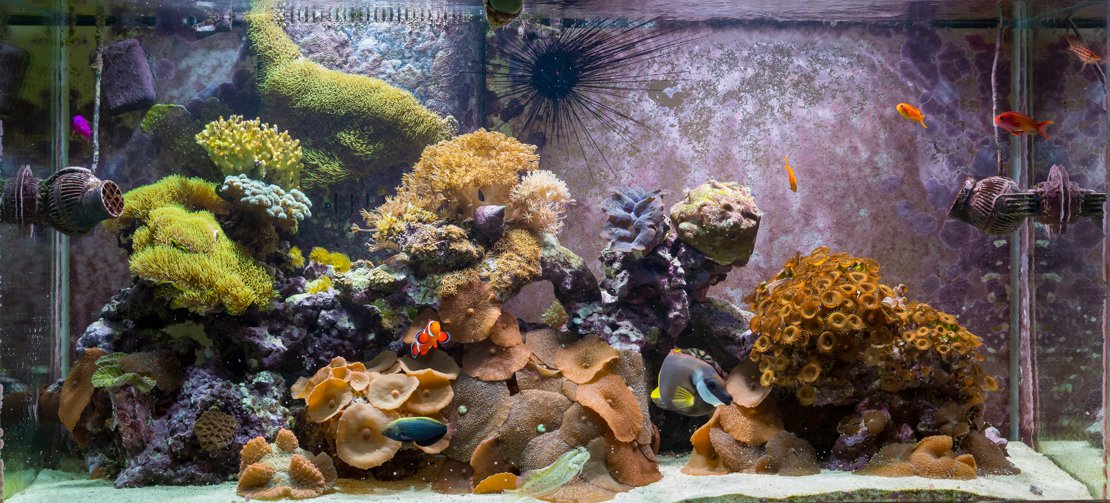
Various personal reasons prompted me to sell most of my equipment and all of my livestock from my new 90g reef aquarium. Needless to say this was rather tragic apart from the obvious loss of your beloved pets, it is a load of money you throw away when you try and sell second hand equipment. On average I received 30% of the value of the original purchase price for most of the items I sold. In some cases even less.
Yesterday, the 2nd of January 2011 I decided to rebuild this tank. I have the same 90g tank, the same chiller, MH lights, heaters and Kalkstirrer from my previous setup. So I set out to JL Aquatics and purchased a new Bubbleking Mini 200 skimmer, 2 x Tunze nano 6055 pumps, an Eheim 1260 return pump, Eheim 1250 water mixing pump, Tunze 3155 Osmolator, Neptune Apex system and lots of plumbing / buckets / etc. Got some 60lbs Aragamax Select sand and D-Deltec H2OPlus salt.
I spent the whole of yesterday to rebuild all the plumbing and reconnect everything.
A lot of the equipment is the same, hence I copied the descriptions where applicable from the previous tank.
Tank
The tank I got is an 90g (340L) Aqueon AGA glass tank measuring 48.5" x 18.5" x 25.375" (L x W x H). It has an off center overflow chamber made of plastic, siliconed with black silicone to the rear panel. Inside are two holes - one for the overflow to the sump using a Durso standpipe, and one for the return line to the tank from the sump.
The cabinet is made from a kind of cherry wood veneer, with no central column and no metal bracing. This is both great and bad. Bad for structural integrity, good for access to the sump. Canopy is open back, and I have two custom made 5mm glass cover plates. The glass panels are 10mm thick. With this design there are three viewable sides.
As the tank does not have anything at the back, I am considering adding a black cardboard to hide the colour of the wall behind it. My first tank had a black background and I liked it.
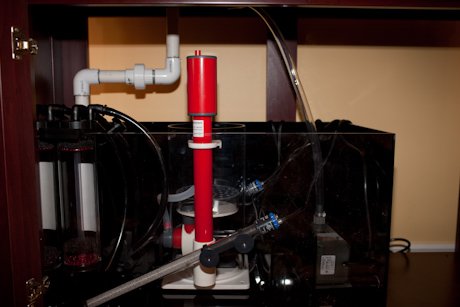
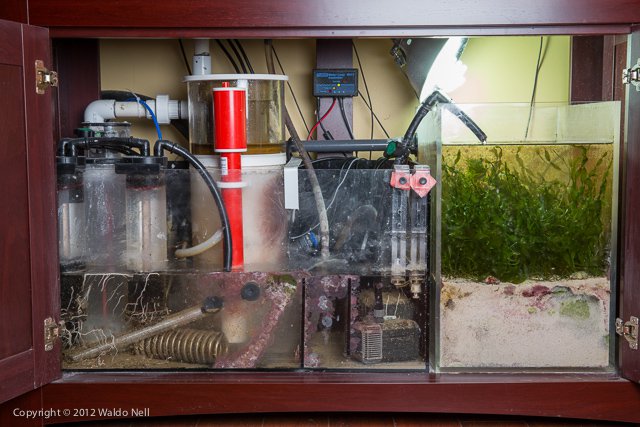
The water flows over the overflow at the back, down the Durso standpipe into the sump beneath. There is a special chamber to supposedly lessen the noise of the falling water. This flows into the three chambered sump. In the first and largest section is my skimmer, two Phosban 150 reactors and two heaters. This flows over an up/down partition to the return pump.
I am keeping cheato in the second chamber with a reverse photosynthesis schedule.
Here is a photo of the sump before and after the water circulation was turned on:
Mechanical Filtration
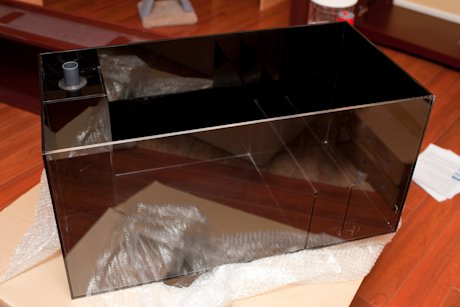
The sump is an acrylic EuroReef RS180/250 sump, measuring approximately 30" x 15" x 15" (L x W x H). Here is a picture:
Chemical Filtration
Two Phosban 150 reactors are used - one with RowaPhos, and the other with GAC (Granular Activated Carbon), helps keep the phosphates and possible unwanted chemicals at bay, and helps prevent yellowing of the water.
Biological Filtration
I only have a 2" sand bed made from CaribSea Aragamax Select sand. This is not deep enough for a DSB, so this sandbed will not form a major part of denitrification. Instead the inhabitants are wholly dependent on the live rock in the tank to perform denitrification. The Cheatomorpha in the refugium (now mostly replaced by Caulerpa) will also somewhat help remove unwanted phosphates and nitrates. A 15cm DSB in the refugium helps with denitirification. Lastly, my BubbleKing Mini 200 skimmer will take care of the DOC's (Dissolved Organic Compounds) before they break down to cause phosphates/nitrates.
Heating/Cooling
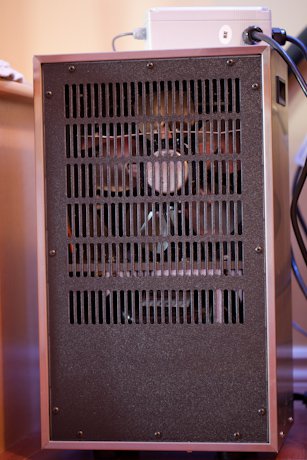
I have two Jager 250W heaters in the sump - together they provide for redundancy. Since this condo never gets colder than about 18C even in the winter without central heating turned on, I believe my biggest concern would be heat in the summer. For this I have acquired an AquaLogic 1/4 HP TLC-3 chiller (drop in sump kind). Seems to work awfully well. As an update, the chiller comes on at least twice a day, even in winter. The heaters almost never turns on as the condo is 90% of the time too warm. Without the chiller the tank would not have lasted more than a couple of days.
Additives/Topup
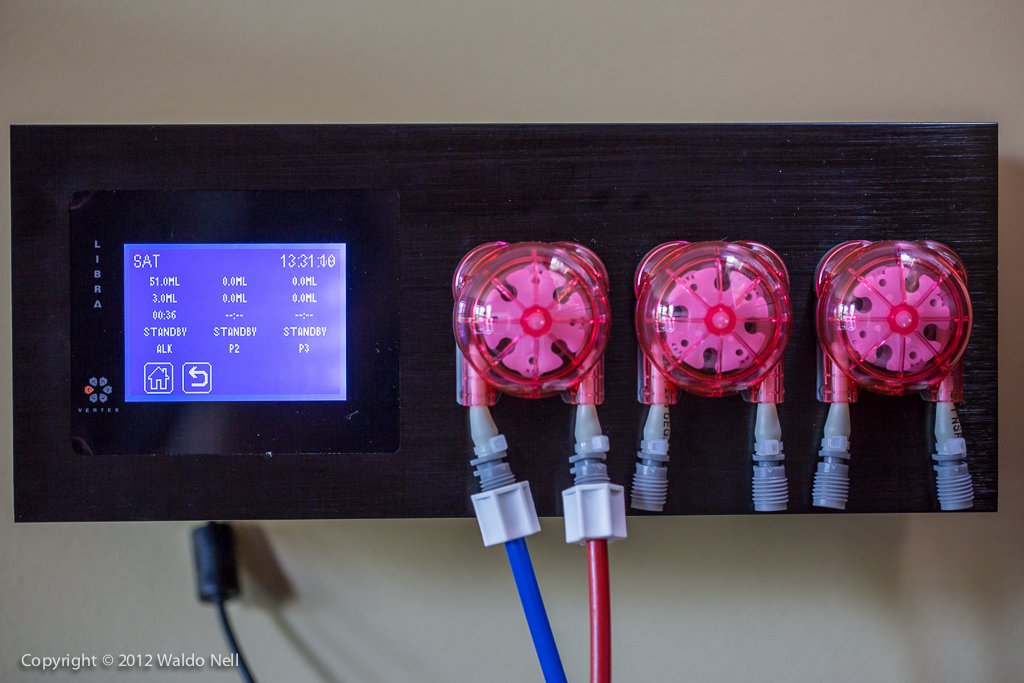
The Tunze Osmolator 3155 is handling the auto topup from a 10g reservoir of RO water. The topup feeds through a Deltec Kalkstirrer that doses Kalkwasser to help keep Alkalinity and Calcium in check. Recently, since about June 2011 my alkalinity keeps dropping. Calcium levels are fine, but alkalinity drops to 4-7dKH. Therefore I added a Vertex Libra dosing pump to dose alkalinity supplement.
Return Pump
Experience has taught me the Eheim pumps - though expensive - are simply the most reliable and quietest pumps out there. I therefore got a 1260 for the return flow, rated at 634gph. I will therefore get about 470gph if you take the head loss in account, or more suitably 5 times the turnover rate of the tank.
Flow
My trusty Tunze pump takes care of the internal flow. This time I got one 6055 and one 6095 nanostreams with the 7095 controller. The Tunze pump comes with a magnet, so no more paying $40 for extra magnets. I have programmed the controller for a straight pulse action, with 4 second between 50% and 100% and night mode turned on. I chose the nanostreams as I had a bit too much flow with the 6105's, and I intend to keep mostly softies only. It does not hurt that they are $100 cheaper a piece.
Lights
For lighting I have a Sunpod HQI 1164, 48" with 2x250W 13000K Giesemann MH pendant installed in the canopy. It gets a bit hot though. I added a small Antec fan to the canopy and this reduced the heat tremendously.
Automation
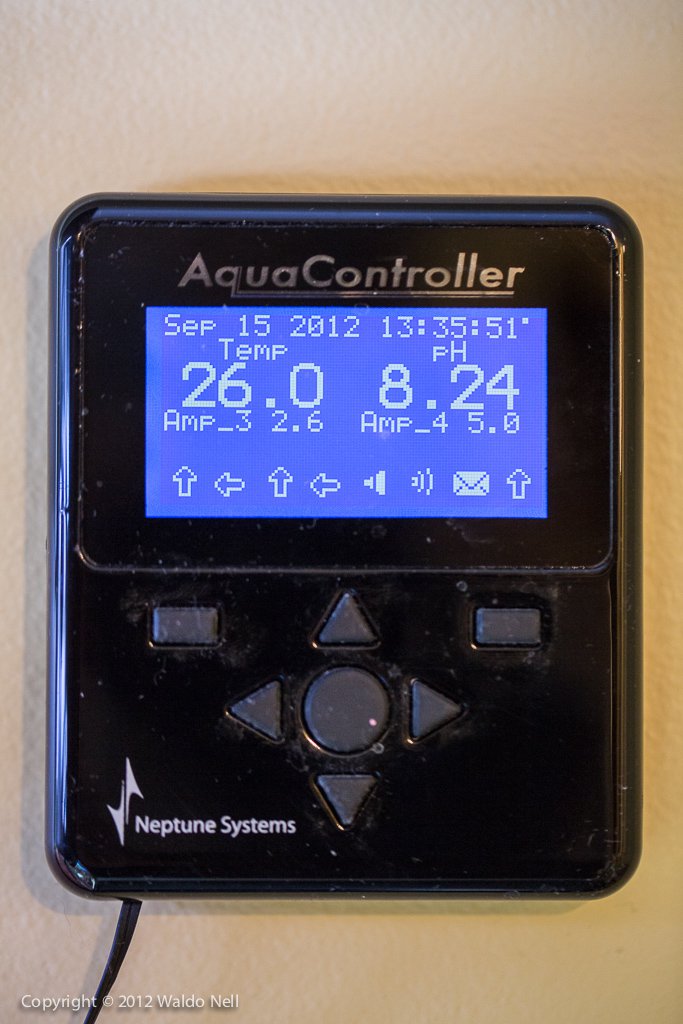
For automation I use the Neptune Apex system - a very capable little controller that seems more powerful than the AquaTronica, however it seems like fewer probes are available (or I do not yet know where to look). It has two 8-way plug bars (I added a second one), a temperature probe and a lab grade pH probe. This system controls my lighting, heaters, chiller and pumps. To further enhance the system, I installed three water level sensors via the 8 port IO socket in the Apex. I built my own breakout box as the official one from Neptune is about $40, and it only consists of a simple DIN plug. I have two sensors in my sump, one measures the low sump level and the other the high sump level. Both sends alerts when triggered. If the water in the sump is too high the system stops the skimmer (to prevent it from overflowing in to the sump) and stops the ATO. If the sump is too low then the pump circulating water from the sump to the refugium is turned off.
The third sensor is in the RO tank, and is triggered when the water level is low. This sends an alarm to me so that I can fill up the reservoir.
Today (15 Sept '12) I installed a new Vertex Libra dosing pump to help automate dosing of alkalinity supplement. I had some initial trouble with it where it would loose suction after a couple of hours. Turns out I had to wrap some plumbers tape around the threads of the Vertex vessel where the outgoing tube connects on top.
Water Parameters
Measured: 15 Sep '12
| Parameter | Value |
|---|---|
| pH | 8.0 - 8.3 |
| Temperature | 25.5 - 27.0C |
| Specific Gravity | 1.025 |
| Ammonia - NH3+NH4 | Undetectable (?) |
| Nitrite - NO2- | Undetectable (?) |
| Nitrate - NO3- | 0.5mg/L [7 Dec '12] |
| Calcium - Ca | 370mg/L [12 Jan '13] |
| Alkalinity | 9.1dKH [12 Jan '13] |
| Phosphate - P | 0.008mg/L [7 Dec '12] |
| Magnesium - Mg | 1450mg/L [23 Jun '12] |
| Silica - Si | 0mg/L [23 Jun '12] |
Feeding
I feed a combination of frozen foods including Brine and Mysis shrimp, frozen cyclopeeze, diced Nori and New Life Spectrum Marine Fish formula.
Maintenance
Monthly 20% water changes are performed with D-Deltec H2O Ocean Pro salt. GAC and RowaPhos are replaced once every 3 months. Since I am a horrible person I clean the pumps / skimmer whenever it stops working. Glass covers are cleaned whenever I feel they are too dirty, that goes for the aquarium glass panes too.
Power Backup
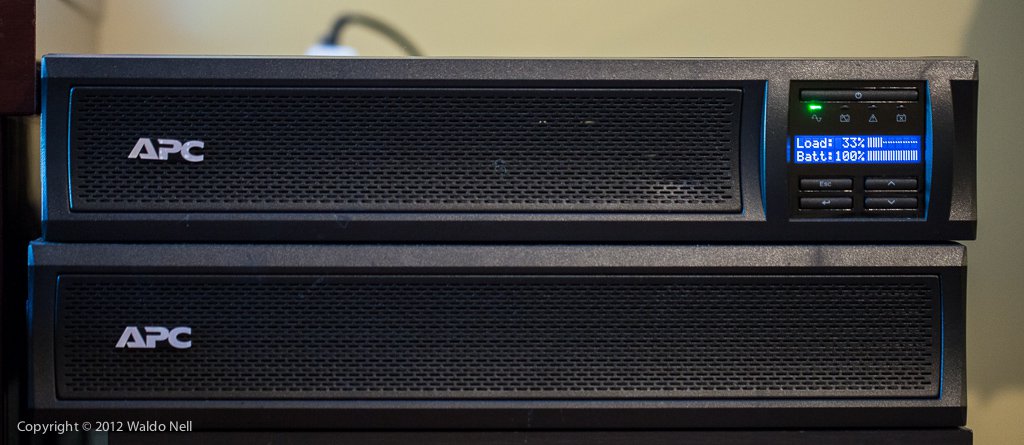
I purchased an APC SMX750 UPS with one extended battery pack. Everything except the chiller, heaters, lights and refugium light is on the UPS. I get 5.5 hours of runtime at 23% load. If I turn off the skimmer I expect to get 9.5 hours of runtime at 17% load.